Frequently Asked Questions
Answer The Company's 6M/2026 sales by product category, by sales channel, and by operation are as follows:
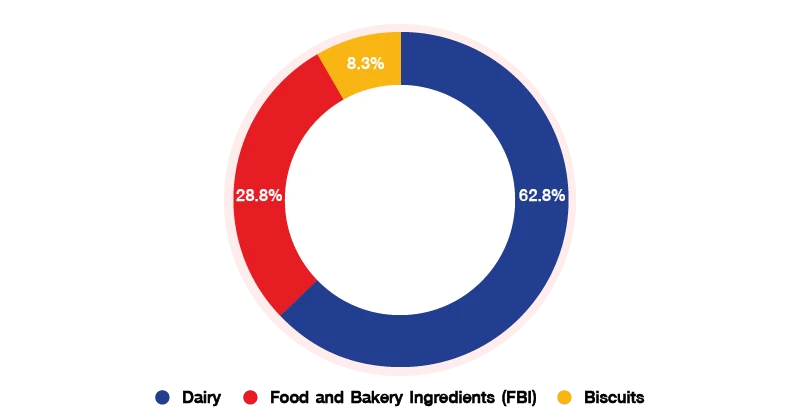
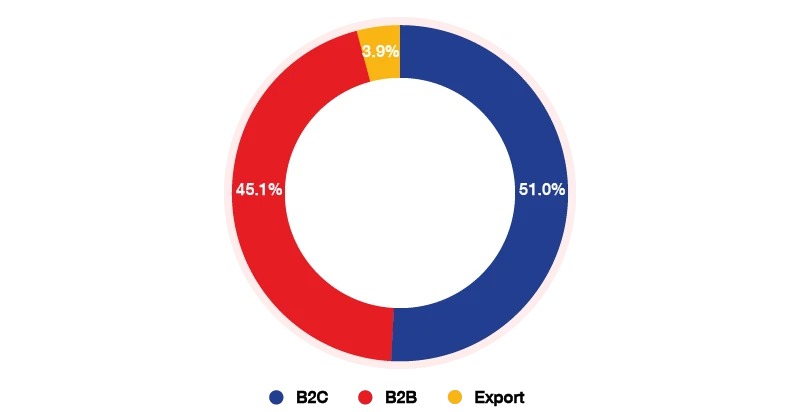
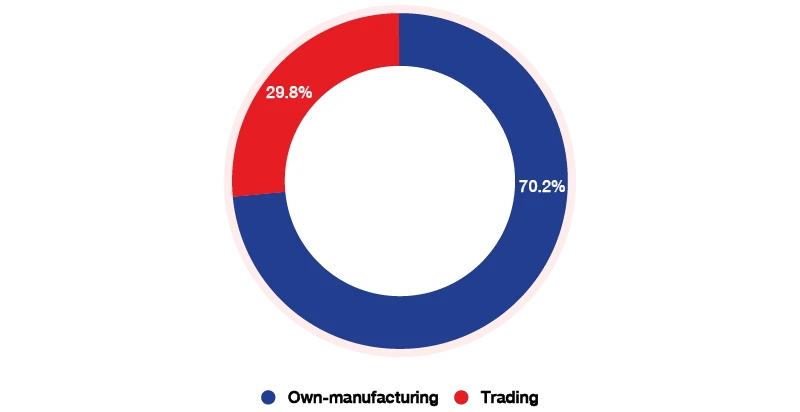
Note: Numbers may not align with the calculation by one decimal point due to rounding of figures.
Answer In 6M/2026, the cost of raw materials accounted for approximately 50.8% of the Company's total cost of goods sold (COGS). The Company’s main raw materials include butter oil/ Anhydrous Milk Fat, cheeses, palm oil, wheat flour, powdered milk, sugar, etc.
Average cost of raw materials in Q2/2026 decreased from the same period last year and declined slightly from the previous quarter. Looking ahead, these raw material costs are expected to be relatively stable in Q3/2026 compared with Q3/2025 and Q2/2026. For the full-year average in 2026, average raw material costs are also projected to decline slightly from 2025 levels. As a result, the gross profit margin in 2026 is expected to improve from last year, supported by the Company’s robust strategic sourcing, enhanced production efficiency, and effective production cost management. These factors are expected to offset the increase in plastic-related packaging costs, which account for roughly 3% of cost of sales.
Answer The conflict involving the US, Israel, and Iran, which began on 28 February 2026, has disrupted global supply chains and increased production costs worldwide. Rising energy prices and logistics costs have consequently driven up the Company's expenses for plastic-related packaging materials and transportation. However, these exposures will be limited; plastic-related packaging accounts for about 3% of cost of goods sold (COGS), while transportation expenses represent around 12% of SG&A.
The Company has implemented the following measures to mitigate the impact of these rising costs:
- The Company has proactively locked in prices for a portion of its plastic-related packaging materials and is coordinating closely with suppliers to ensure sufficient and uninterrupted procurement of products and packaging materials.
- Transportation efficiency is enhanced by optimizing delivery routes and consolidating shipments for goods traveling along the same route to maximize load capacity.
- The Company upgrades to energy-efficient equipment to improve energy consumption, reduce production costs, and support environmental sustainability.
- Focuses on improving operational efficiency while enforcing strict cost management and expense control across all departments.
Answer %SG&A to Sales in Q2/2026 and 6M/2026 continued to decline compared with the same period last year. This improvement was driven by continuously improving operational efficiency and expense management across the entire supply chain through the adoption of digital technologies to enhance the accuracy of sales forecasting, inventory management, and workforce planning and management. These initiatives will enable the Company to effectively control and manage operating expenses on an ongoing basis.
Answer The Company purchases in foreign currencies approximately 50% of COGS. However, the Company meticulously manages exchange rates and hedges the foreign exchange rates by buying forward contracts. The Company also has a foreign currency deposit account (Foreign Currency Deposit or FCD), which will help reduce the impact of exchange rate fluctuations.
Answer The Company has strong and well-known products that have been trusted by consumers for a long time. The Company also has a flexible value chain, allowing the Company to create new products for customers and promptly meet customer needs from the following components.
- Production plants certified by international standards for food industry quality and standards, such as GHP (Good Hygiene Practice), HACCP, ISO9001: 2015, Halal and Hal-Q.
- Various distribution channels throughout Thailand, including Business-to-Business (B2B), Business-to-Customer (B2C), online, and exports to 15 countries.
- Efficient logistics including temperature-controlled transportation, which is very important to maintain the freshness and quality of the products.
- Innovation excellence under KCG Excellence Center, which focuses on research, development, and innovation for new product development. The Company is also fully equipped with laboratory, equipment, technology, and personnel such as the RDI (Research Development and Innovation)/ Professional Chefs of the Company that help develop delightful recipes/ Sales and marketing that understand customer needs, which enhances the Company to quickly respond to the needs of both B2C and B2B customers, supported by the Company’s ability to create new menus that keeps up with consumer trends that change quickly, ability to provide solutions to B2B customers starting from creating menu, developing specific formulas for each customer, adjusting the production formulation, controlling production quality in the commercial scale, and efficiently managing the optimal production costs.
Answer The Company is the market leader in both the butter and cheese product categories. Its Butter and Spreads products hold the No. 1 market share at 46.5%, while its Cheese products hold the No. 1 market share at 38.9%. For Sweet Biscuits, the Company also ranks No. 4 with a market share of 6.1%.
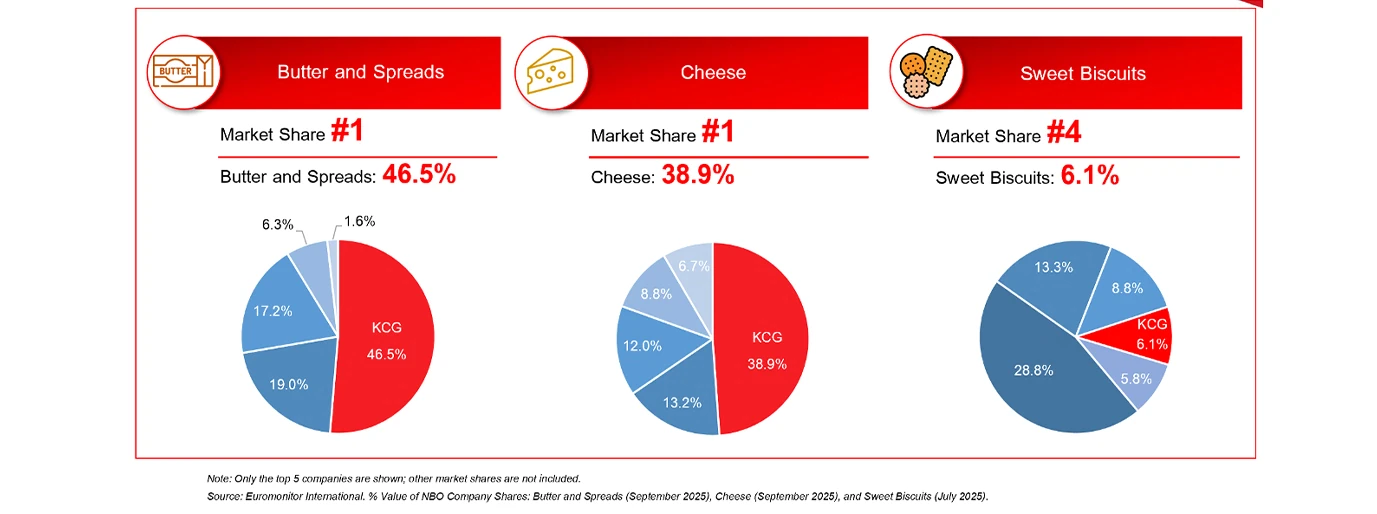
Answer The market share data reported by the Company in 2021 were based on a custom report prepared by Euromonitor International, covering both B2B and B2C markets. In contrast, the 2025 market share data cover B2C markets only. Additionally, the product category classifications differ between the two reports. For example, in 2021, the data covered only the Butter market, whereas in 2025, it covers the Butter and Spreads market. Similarly, Biscuits data in 2021 reflected the Plain Biscuits segment (a subcategory of Sweet Biscuits), while in 2025, the data cover the overall Sweet Biscuits market.
Answer Regarding the Thailand–European Free Trade Association (EFTA) Free Trade Agreement, which involves four member countries — Switzerland, Norway, Iceland, and Liechtenstein — the negotiations are expected to take some time to conclude. Tariff reductions will be implemented gradually and will not immediately drop to 0%.
The Company does not expect the FTA with Europe to place it at a competitive disadvantage. As a leader in the dairy products industry, the Company operates its own high-standard cold-chain logistics transportation system, which enhances its ability to form potential partnerships with European companies. In addition, the Company has already prepared by developing products using raw materials sourced from Europe. Products made from European raw materials offer distinctive taste profiles compared to those sourced from Australia and New Zealand. The Company can also expand its imports of European products beyond its current portfolio, providing a wider range of product offerings and potentially benefiting from lower raw material and product costs in the future.
Answer The U.S. has imposed a 12.5% tariff on imports from Thailand, which is in line with several neighboring countries, including Vietnam, the Philippines, Singapore, and China. Although the tariff rate is higher than that of some countries, such as Indonesia and Malaysia, the Company expects the impact on Thailand’s competitiveness to be limited. Furthermore, the Company will not be directly affected by the tariff, as it does not export products to the U.S. In addition, the Company may have opportunities to increase imports of raw materials or finished products from the U.S. if import tariffs are reduced to a level that makes the import costs economically viable. This would provide the Company with greater sourcing options and access to more competitive raw materials and products.