Waste and Pollution Management
The Company’s business operations, including production, transportation, and other supporting activities throughout the value chain, are involved in the generation of waste and emissions affecting water, air, and noise levels. If not properly managed, these impacts could affect environmental quality as well as the health and well-being of surrounding communities and may expose the Company to regulatory non-compliance risks and potential loss of stakeholder confidence. The Company recognizes this as a sustainability material topic requiring systematic and proactive management to mitigate negative impacts while supporting long-term business growth in balance with social and environmental responsibilities.
Policies and Management Approach
The Company has established systematic policies and guidelines for waste and environmental pollution management by applying the ISO 14001:2015 Environmental Management System to enhance the efficiency and effectiveness of environmental impact control. The Company emphasizes waste reduction at the source, efficient resource utilization, research and development to enable the reuse of waste and degraded materials, and effective control of water, air, and noise pollution in compliance with applicable laws, standards, and stakeholder expectations.
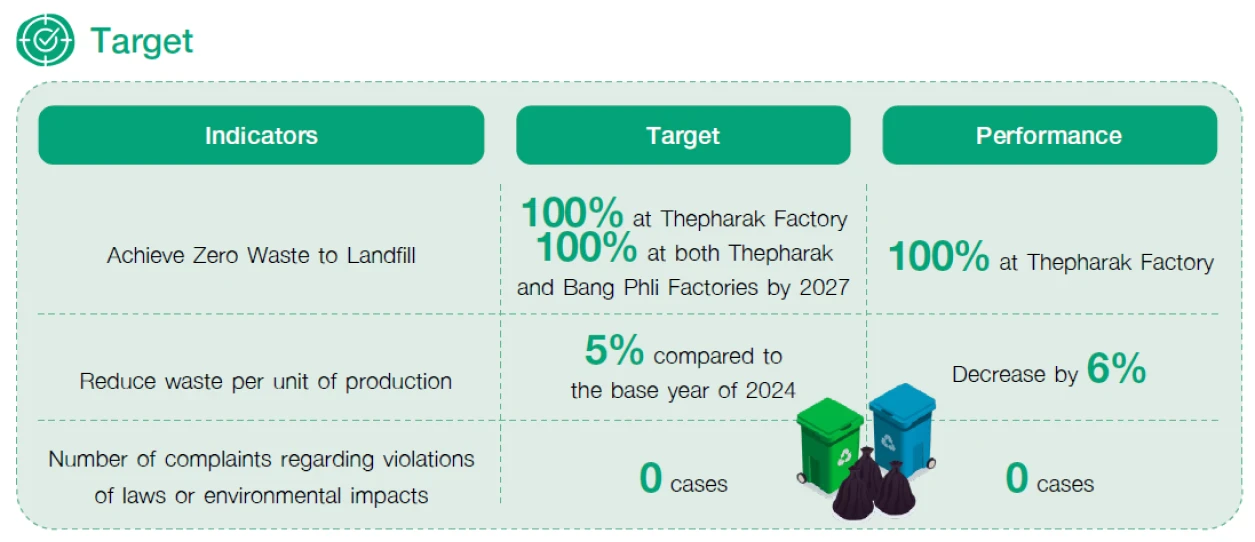
The Company continuously improves and strengthens its environmental management by setting both process-based and quantitative targets for waste and pollution management, including a goal of achieving zero waste to landfill by 2027. Key performance indicators are established, and waste reduction per unit of production is reported annually. These targets are aligned with the Company’s greenhouse gas emission reduction pathway and Net Zero goal.
1. Waste Management
The Company prioritizes minimizing waste and garbage generated from its production processes by adopting a 3Rs waste management approach: Reduce, Reuse, and Recycle. This approach aims to achieve the Zero Waste to Landfill goal. The waste management process includes segregation, storage, disposal, and documentation of waste, along with reporting to government agencies in compliance with legal requirements. The Company also promotes environmental awareness among employees by providing knowledge and understanding of waste disposal regulations and practices, as well as encouraging the reduction of production waste.
The types of waste and the management methods are as follows:
- Hazardous waste consists of waste or leftover materials that contain or are contaminated with hazardous substances or have dangerous properties as defined by the Ministry of Industry. This includes electrical and electronic equipment, containers and materials contaminated with oil or chemicals, oil, lubricants, and infectious waste from hospital rooms. These are managed by segregating and storing them in designated hazardous waste storage rooms with labeled indications. They are then disposed of by a hazardous waste disposal contractor authorized by a government agency through methods such as mixing with fuels, secure landfill, or incineration. Infectious waste is separated and securely bagged with tight closures. The Company has a contract with the hospital as a service provider to ensure proper disposal of infectious waste in compliance with relevant laws and regulations.
- Non-hazardous waste from the production process includes materials such as sludge, fat sludge, spoiled products, oil (cheese scraps, butter scraps, and flour scraps), raw materials, product packaging (metal buckets, plastic buckets, plastic, cling wrap, plastic bags), general office and cafeteria waste, food scraps, etc. The waste management method involves segregating these wastes into small groups before collecting and discarding them at designated points on a daily basis, according to the labeled indications to be sorted and used for recycling or repurposed into compost, soil conditioner, or animal feed. This waste can be disposed of by a waste disposal contractor authorized by the government agency through methods such as segregating waste for fuel production or sanitary landfills.
Waste Management Projects
Zero Waste to Landfill Project
The Company is committed to achieving 100% zero waste to landfill. By the end of 2022, the Theparak Factory transitioned its waste management approach for non-recyclable waste from landfilling to controlled incineration. The incineration system is equipped with emission control technology to manage gas and particulate matter, minimizing environmental impacts. Incineration ash is managed in accordance with scientific waste management principles, and the recovered thermal energy can be reused, such as for steam or hot water generation. At the same time, the Company continues to implement waste segregation to maximize recycling. As a result, the Theparak Factory has achieved zero waste to landfill in 2025. The Company plans to extend this approach to the Bang Phli factory and, ultimately, across the entire organization in the long term.
General Waste Reduction Project
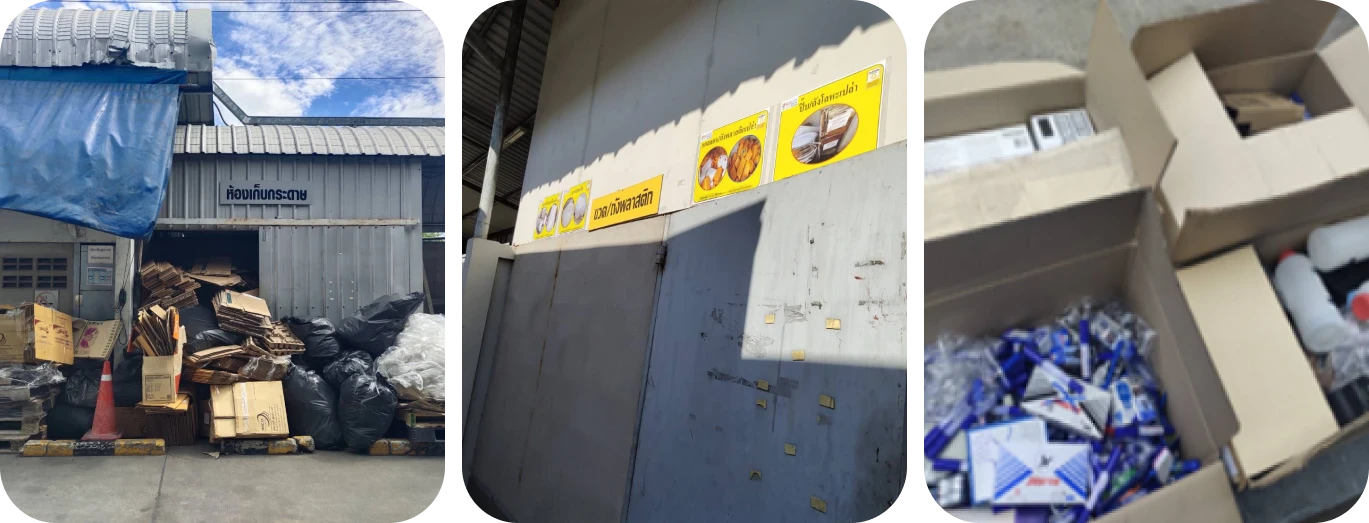
To foster an environmental culture within the organization, the Company promotes environmentally responsible behaviors among employees by implementing waste segregation for recyclable material, such as segregating plastic bottles, glass bottles, and aluminum cans within its factories. This project helps reduce the volume of waste requiring incineration or landfill disposal.
In addition, plastic bags generated from production and raw material preparation processes are segregated to prevent contamination and combined with other recyclable materials for collection and sale into the recycling system. These measures help reduce the volume of general waste requiring disposal and significantly improve overall resource efficiency.
Furthermore, the Company organizes annual activities for employees to promote environmental awareness, as follows:
Segregation of recyclable waste generated from the production process for recycling management.
Reduction of Non-Conformity Products and Raw Materials
The Company has established a systematic and collaborative approach to managing non-conforming products across the organization. This approach emphasizes root cause analysis at each operational procedure and process improvement from the upstream stage, including the standardization of work procedures, the introduction of additional quality control checkpoints at critical stages, and the implementation of an ERP system to enhance the accuracy and efficiency of raw material planning. These measures are integrated with broader process improvements to minimize resource losses in production and related activities.
In addition, the Company fosters a culture of participation and continuous learning by encouraging employees at all levels to report issues and propose constructive resolutions. This collaborative approach strengthens organizational learning and effectively prevents the recurrence of problems.
Through these efforts, the Company has significantly reduced operational waste, including raw materials, packaging materials, work-in-progress, and finished goods. As a result, resource utilization has improved, rework has been reduced, production costs have declined, and overall process efficiency and product quality have been enhanced, which is a strong foundation for sustainable long-term business operations.
Performance on Waste and Pollution Management
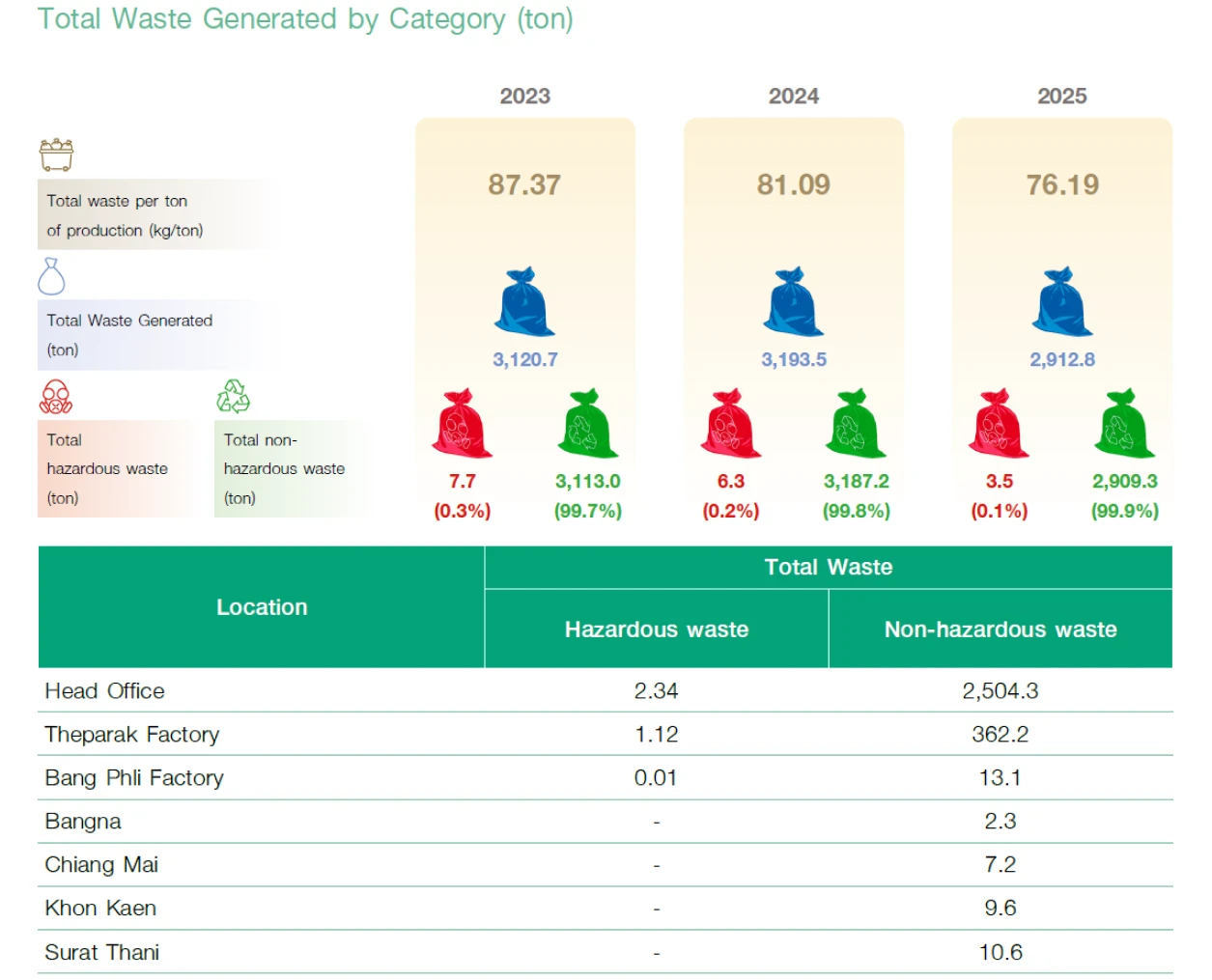
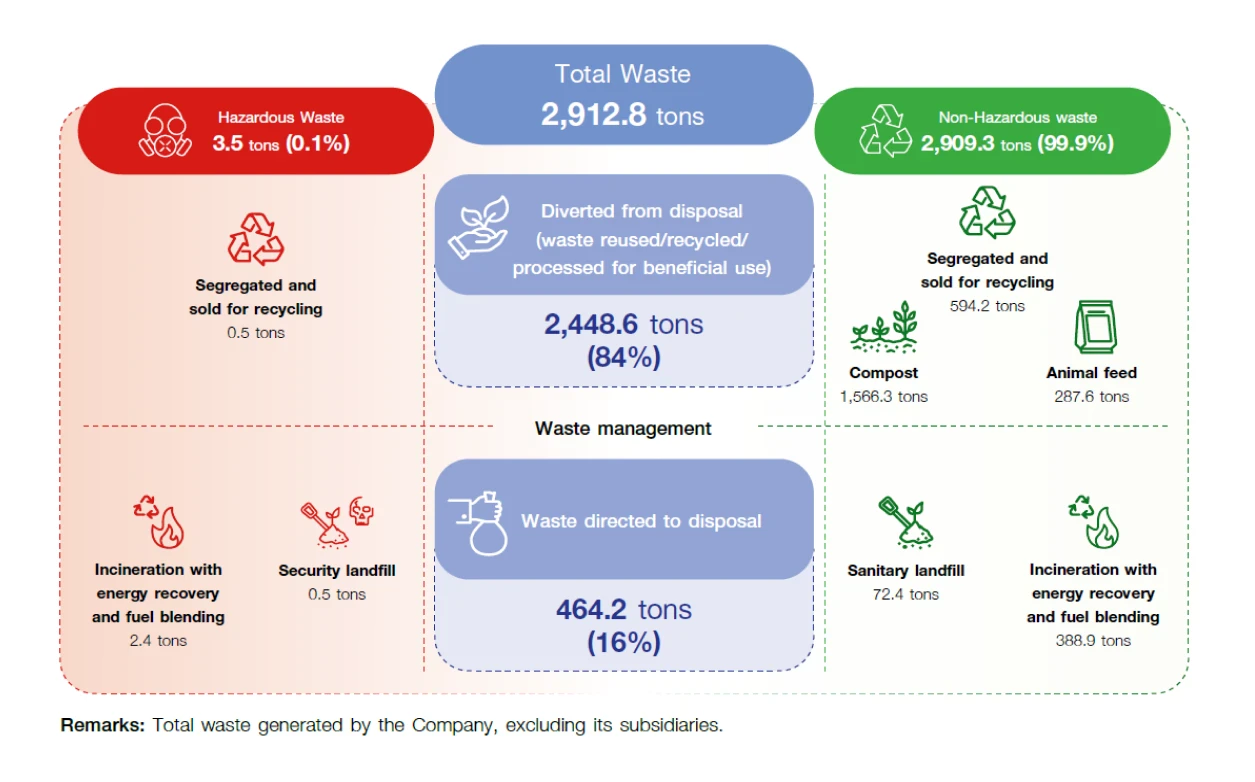
In 2024, the total amount of waste and garbage was 2,912.8 tons, a decrease of 8.8% compared to 2024 This rise was attributed to the expansion of the butter and cheese production lines, the construction of KCG Logistics Park, and the renovation of Theparak Factory. However, over 99% of the waste consisted of garbage and non-hazardous waste. The Company has reduced waste per ton of production from 81.09 kilograms to 76.19 kilograms per ton, representing a 6% decrease, and the proportion of waste recycled and reused is 84% of the total waste.
2. Food Waste Management
The Company has established a Food Loss and Food Waste Policy to support sustainable business operations while maintaining strict compliance with food quality and safety standards. The policy aims to reduce food loss and waste at every stage of production and operations, maximize the efficient use of raw materials, and minimize environmental impacts. This policy aligns with FSSC 22000 requirements by implementing preventive measures at the source, including enhancing production efficiency, improving raw material procurement planning, and optimizing inventory management to reduce product expiration. The Company also continuously promotes awareness and a sense of responsibility among employees and stakeholders throughout the value chain.
The Company has implemented the following measures:
- Reduce food loss from raw material sourcing, production, storage, transportation, and the management of non-conforming products, in collaboration with relevant stakeholders.
- Manage food waste efficiently and sustainably.
- Improve resource utilization to enhance cost efficiency and continuously strengthen related operational processes.
- Promote awareness and instill a sense of responsibility among all employees and stakeholders.
- Regularly monitor, measure, and review food loss and waste performance.
- Establish indicators for reducing food waste and report performance results to senior executives on a monthly basis.
- Implement safety procedures to manage non-conforming products without compromising food safety.
For more information available in:
Management Approach
Food Waste Management
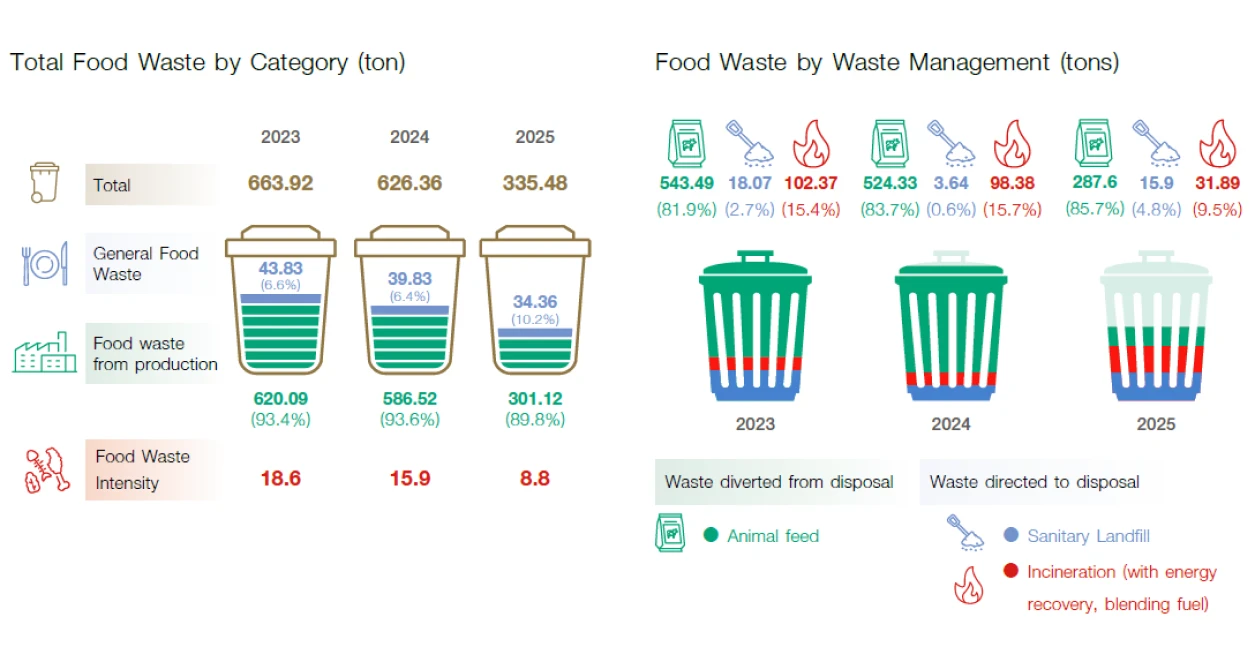
The Company's food waste is categorized into two types and managed as follows:
- Food waste from production includes deteriorated products that can be reused, such as cheese scraps, butter scraps, and flour scraps. These are managed by segregating and selling them for further processing, such as turning them into fertilizer, components for agricultural planting materials, or raw materials for animal feed.
- General food waste from the office or cafeteria, such as food scraps, vegetables, and fruits, constitutes a smaller proportion compared to the waste from production. The Company separates this food waste at the cafeterias of both the Bang Phli Factory and Theparak Factory and disposes of it through the municipality for sanitary landfill.
Reduction of Waste from Production Processes
The Company is committed to reducing waste generated from production processes under the quality management system and non-conforming product management guidelines. This includes the continuous review and improvement of production, storage, and transportation processes for raw materials, packaging materials, and trading products to ensure product quality for sale and to minimize waste throughout the supply chain.
Knowledge Sharing from External Organizations for Employees
Performance
In 2025, food waste decreased by 46.4%, and food waste intensity per unit of production decreased by 44.8% compared with 2024. This reduction was primarily driven by a decrease in food waste generated from the production process.
3. Air Pollution Management
The Company prioritizes air quality management in the workplace and surrounding communities, developing a plan to ensure air quality meets standard criteria and exploring ways to improve the system. The Company consistently improves air quality by establishing clear goals and regularly measuring and monitoring air quality to ensure regulatory compliance and stakeholder confidence. This includes implementing eco-friendly measures to ensure that air quality standards are met and continuously improving the Company's air quality control systems.
- Air Pollution Control
The Company has a Preventive Maintenance (PM) plan for hood systems installed in various locations, including the boiler. This includes monitoring and inspecting the laboratory's fume hood systems, as well as the cheese pot and boiler once a year to ensure that they can properly filter the air before it is released outside the factory.
- Air Quality Monitoring at Factory Chimneys
The Company conducts stack emission monitoring at the factory chimney tips twice a year, as required by law, to assess emissions released into the atmosphere. A certified private analytical laboratory accredited under ISO/IEC 17025 standards is engaged to perform the monitoring in accordance with the Notification of the Ministry of Industry B.E. 2549 (2006) on the permissible levels of chemical contaminants discharged from factories.
The monitoring parameters include:
- Total Particulate Matter (TSP)
- Sulfur Dioxide (SO2) and Nitrogen Oxides (NOx as NO2)
In 2025, the Company’s annual stack emission monitoring at both manufacturing facilities complied with all applicable legal requirements and did not result in any adverse impacts on surrounding communities.
4. Environmental Complaints Management
The Company has established a systematic process for receiving and handling complaints in accordance with ISO 14001:2015 standards, ensuring proper classification and appropriate management of each type of complaint. Various channels are available for stakeholders affected by environmental pollution to report issues directly, enabling the Company to take prompt corrective action. Additionally, the Company compiles and summarizes complaint resolutions for regular reporting and continuous improvement.
Performance
In 2025, the Company had no incidents of oil or chemical spills affecting the environment and surrounding communities. Additionally, there were no complaints regarding waste management, air pollution, or other environmental pollution from surrounding communities or government agencies.
KCG Sustainability Performance Data 2025 - Environmental Performance