Sustainable and Responsible Supply Chain Management
Changes in economic and social conditions, together with climate change risks, have increased the complexity and uncertainty of the Company’s supply chain management. These factors affect the continuity of raw material supply, production costs, transportation, and supplier operations, many of which are subject to environmental, social, and governance (ESG) challenges. These changes present operational risk factors. However, it also presents opportunities to strengthen business capability and resilience in the supply chain in the long term.
The Company has therefore established sustainable supply chain management as a core business strategy, aiming to manage the supply chain efficiently, transparently, and responsibly to strengthen its ability to achieve objectives while preventing and mitigating potential environmental, social, and economic impacts arising from the operations of the Company, suppliers, and stakeholders throughout the supply chain.
To manage these risks, the Company conducted a supplier sustainability assessment and promoted a corporate governance code to mitigate risks for supply chain disruption, reputational damage, and non-compliance with applicable laws or related standards. Furthermore, the Company emphasizes long-term collaboration with suppliers through potential development, knowledge sharing, and collaborative innovation to enhance supply chain competitiveness and foster mutual growth and long-term sustainability.
Policies and Management Approach
The Company recognizes that suppliers business operations can impact overall goals, not only in economic goals but also in social and environmental dimensions, such as raw material and product safety, regulatory violations, human rights violations, pollution, and environmental issues, including increased greenhouse gas emissions, waste management, and safety of life and property, etc. The Company established a sustainable supply chain policy and related practices by integrating supplier management into relevant operations, identifying critical suppliers, and classifying those with high ESG risks. This approach aims to mitigate supplier risks and foster a unified effort toward Environment, Social, and Governance (ESG). Details of the Sustainable Supply Chain Policy are as follows:
- Establish strategies and practices for managing the supply chain effectively, transparently, fairly, and verifiably, in compliance with all applicable laws, rules, and regulations.
- Establish mechanisms for sustainable supplier management by integrating Environmental, Social, and Governance (ESG) criteria into supplier procurement and selection, supplier audit, and supplier collaboration development to ensure suppliers’ compliance with the Company’s sustainability policy.
- Commit to sourcing high-quality raw materials and products from suppliers who comply with relevant environmental laws and standards, considering their environmental responsibilities and impacts on biodiversity. This includes efficient energy and water management, sustainable agricultural and livestock practices, the prevention of deforestation, responsible chemical management, animal welfare certification or equivalent standards, and the implementation of raw material traceability systems.
- Establish partnerships with suppliers to manage greenhouse gas emissions and support the achievement of the Company’s long-term greenhouse gas emission reduction targets.
- Promote and prioritize respect for labor rights and human rights among suppliers, such as fair wages, occupational health and safety management, appropriate working conditions, and the elimination of child labor and forced labor. The Company also encourages suppliers to adhere to human rights principles and labor standards at both national and international levels.
- Support procurement from local suppliers, workers, and businesses in areas where the Company operates to promote the local economy, employment, and income distribution.
- Disclose and communicate the Company’s sustainable supply chain policy, supplier code of conduct, and business ethics as a framework for sustainable collaboration throughout the supply chain. In addition, whistleblowing and complaint channels have been established to receive cases of unfair practices or suspected corruption
For more information available in:
Sustainable Supply Chain Management Approach
To ensure effective implementation of the sustainable supply chain policy and to foster cooperation from suppliers in developing sustainability, the Company has established supplier management guidelines covering identification of suppliers, supplier recruitment and selection, supplier assessment, and development of supplier collaboration. The details are as follows:
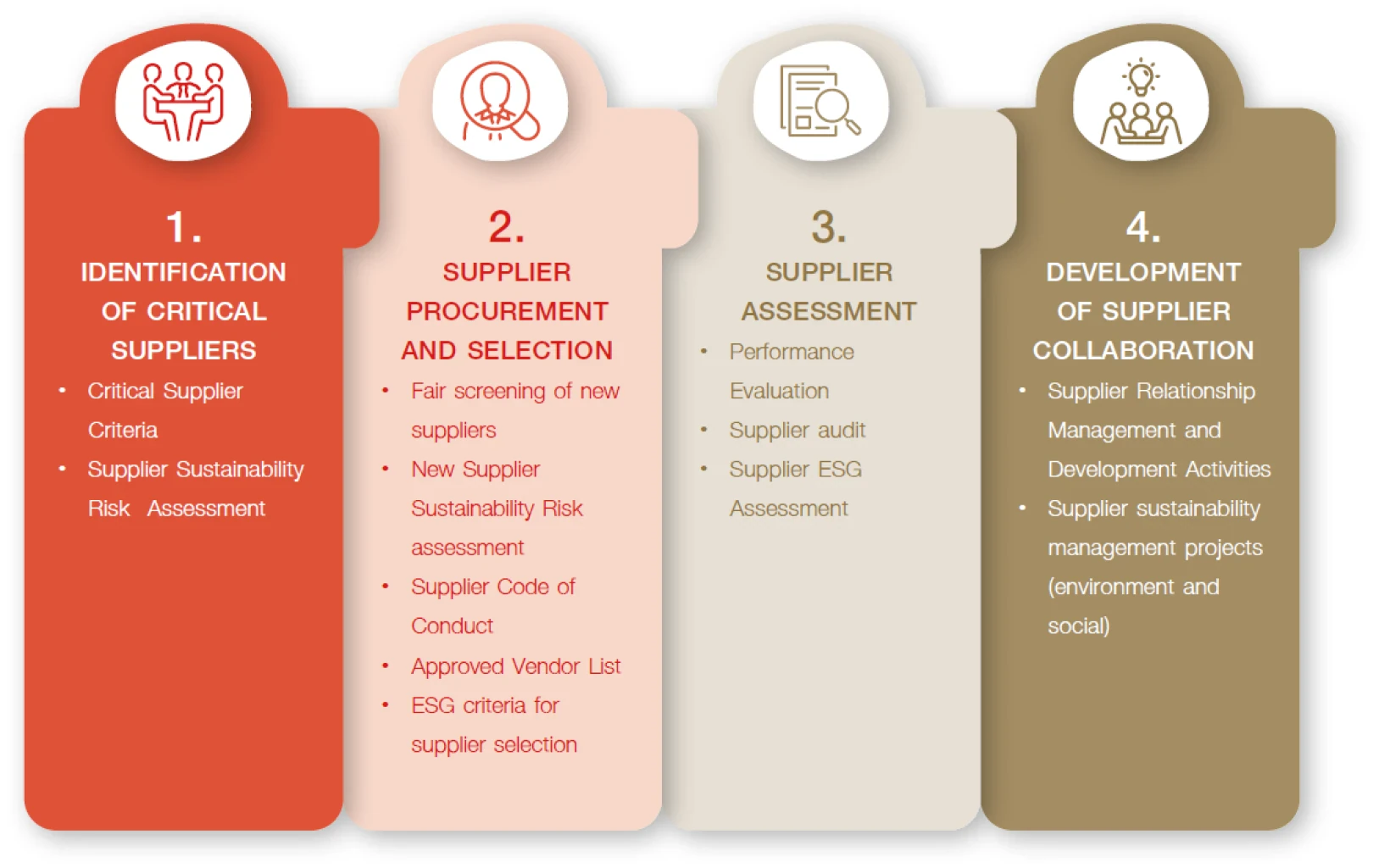
1. Identification of Critical Supplier
- Setting Criteria and Identifying Critical Suppliers
To evaluate the significance of suppliers, the Company has established classification criteria to clearly identify critical suppliers, determine their importance, assess sustainability risks, and manage suppliers appropriately. The criteria are as follows:
1. Critical Tier 1 Suppliers are key suppliers that conduct business directly with the Company and meet the following criteria:
- The value of raw material purchases is within the top 80% of the Company's total annual purchase value.
- Level of Business Dependency: Suppliers that provide key raw materials or trading goods that are critical to the Company’s operations and cannot be readily substituted in the short term.
- Pose ESG risks, such as environmental impacts, labor violations, or vulnerabilities related to climate change.
2. Critical Non-Tier 1 Suppliers This refers to suppliers that do not have a direct sales contract with the Company but play a significant role in or have an impact on the Company’s operations, such as manufacturers of key raw materials, product manufacturers, or intellectual property rights holders whose products are sold to the Company through agents, etc.
- Supplier Sustainability Assessment
The Company assesses supplier risks that may impact both the economic and ESG dimensions, including:
- Environmental risks, such as waste and pollution management, non-compliance with environmental laws, climate change, reduction of greenhouse gas emission, etc.
- Social risks, such as the quality and safety of raw materials and products, human rights violations, occupational health and safety, and personal data security.
- Governance and Economic risks such as corruption, ethical disputes, etc.
The Company requires suppliers to assess sustainability risks through self-assessments, and purchasers use publicly available evidence for foreign suppliers or interview their references. Guidelines have been established for high-risk suppliers to have an on-site assessment at their facilities. If an on-site assessment is not feasible, an online meeting must be arranged promptly to determine a risk mitigation plan.
- Critical Supplier and High-Risk Supplier
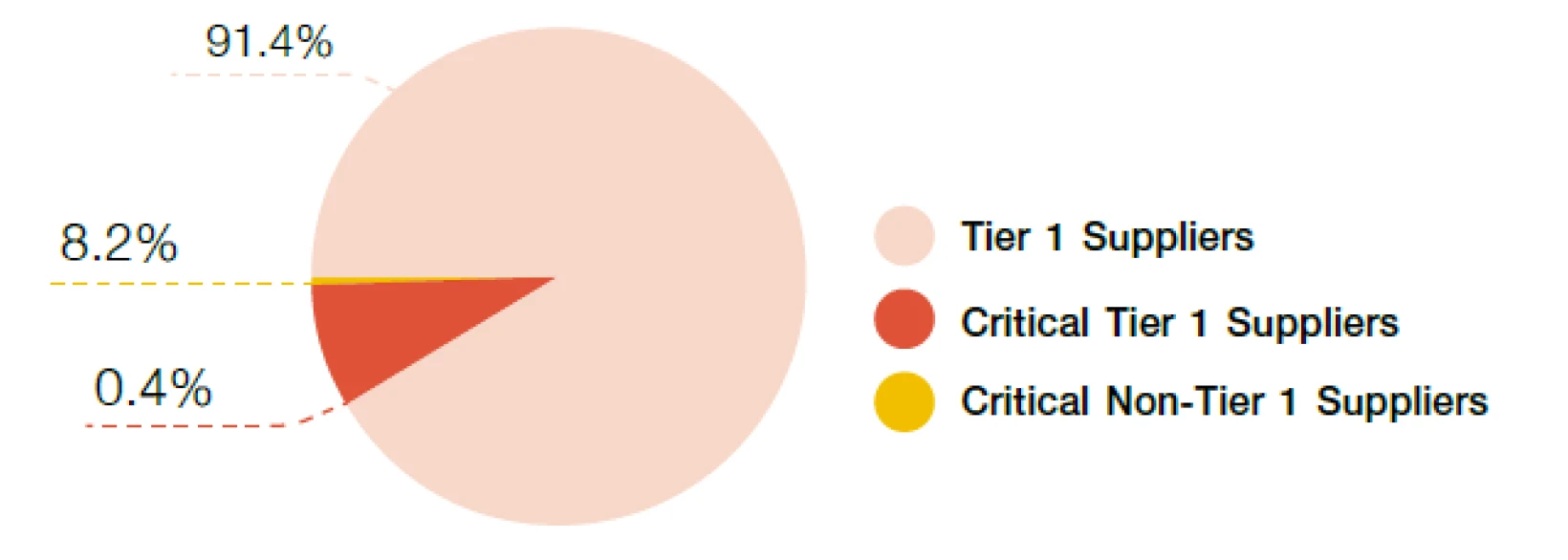
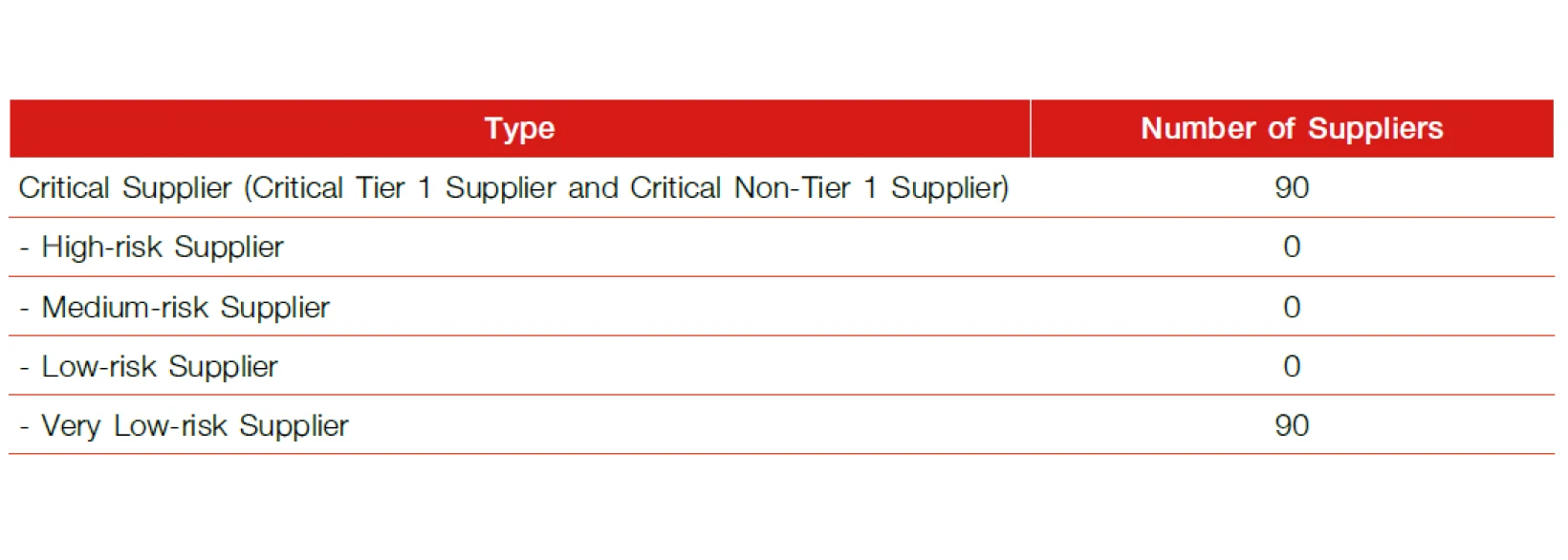
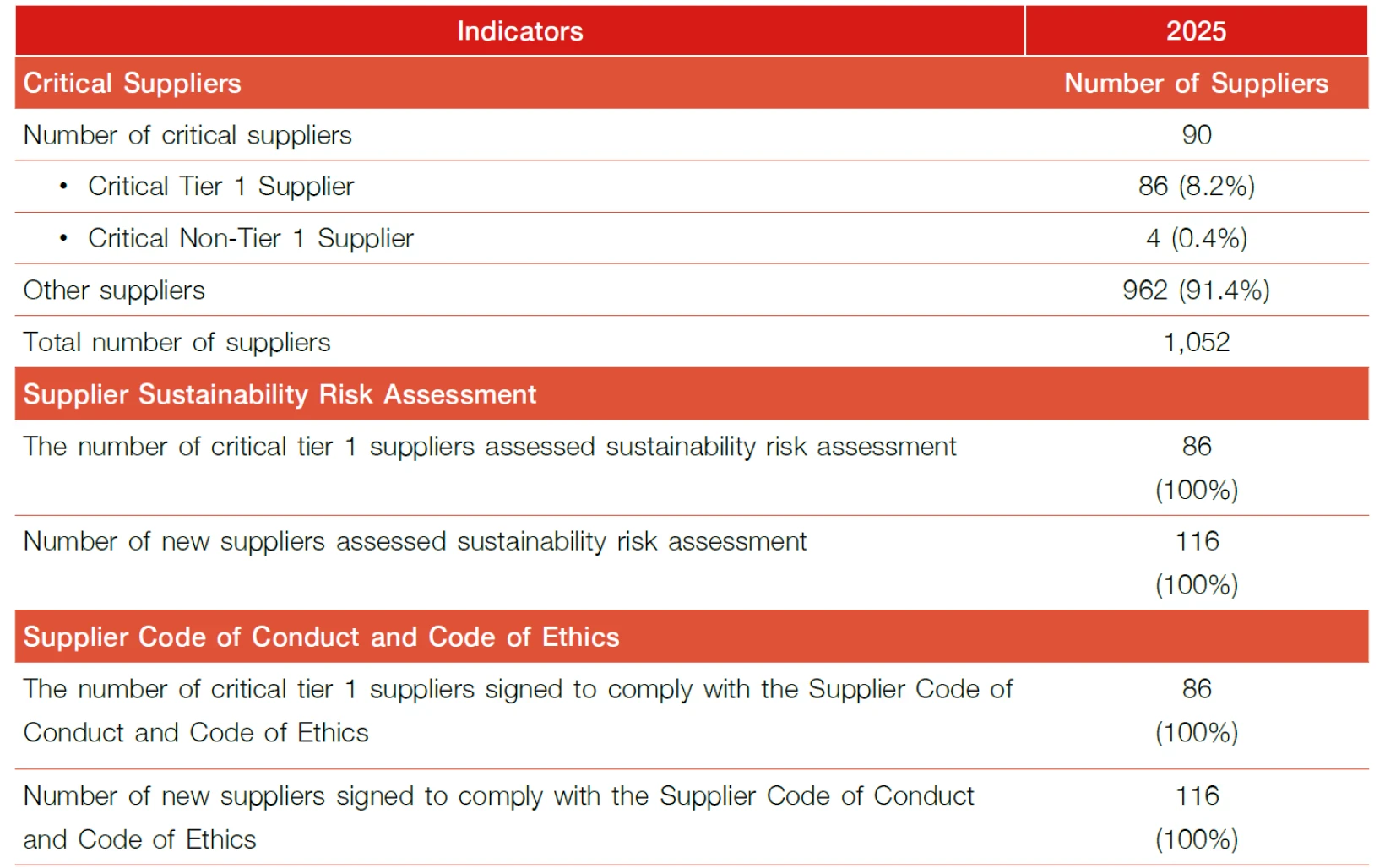
In 2025, the Company had 86 critical Tier 1 suppliers that conducted direct business with the Company, representing 8.2% of the total supplier base of 1,052 suppliers. Critical Non-Tier 1 suppliers, 4 suppliers, represented 0.4% of the total supplier base. The number of both Critical Tier 1 and Critical Non-Tier 1 suppliers changed from the previous year due to a review of the supplier identification criteria, particularly adjustments to the annual purchase value. However, the Company has included suppliers that do not conduct direct business with the Company but provide key raw materials or goods in the Approved Vendor List. In 2025, the risk assessment results for Critical Tier 1 suppliers did not show any high-risk suppliers; therefore, no on-site sustainability audits were conducted for this group.
2025 Supplier Sustainability Risk Assessment Results
2. Supplier Procurement and Selection
The Company prioritizes fair and transparent procurement and selection of new suppliers, as well as setting the evaluation criteria for supplier audit and sustainability assessment. The Company has an e-procurement system that enables suppliers to complete applications and submit essential supporting documents. This system is designed to safeguard data security and ensure the confidentiality of supplier information. The information received is used solely for trading or supplier management activities, ensuring data protection and preventing data breaches or misuse of information.
The criteria for selecting new suppliers include a business score based on factors such as product characteristics in accordance with industrial standards, production capacity, quality management, delivery capabilities, and business sustainability, including social and environmental issues.
The purchasing department considers the evaluation results of the sustainability self-assessment of new suppliers and supporting documents for the Approved Vendor List.
- Communicating the Company’s Policy and Supplier Code of Conduct
The Company established a Supplier Code of Conduct to ensure suppliers understand and adhere to sustainable best practices. The Company prepared the Supplier Code of Conduct and Business Ethics which includes material topics such as code of ethics, community and environmental responsibility, human rights, fair labor treatment, occupational health and safety, etc. This aimed to serve as sustainability guidelines for suppliers.
New suppliers must acknowledge and sign the Supplier Code of Conduct and Supplier Code of Ethics. The Company plans to expand the process of disclosing the supplier Code of Conduct, fostering cooperation to implement the Code of Conduct across all suppliers in each group.
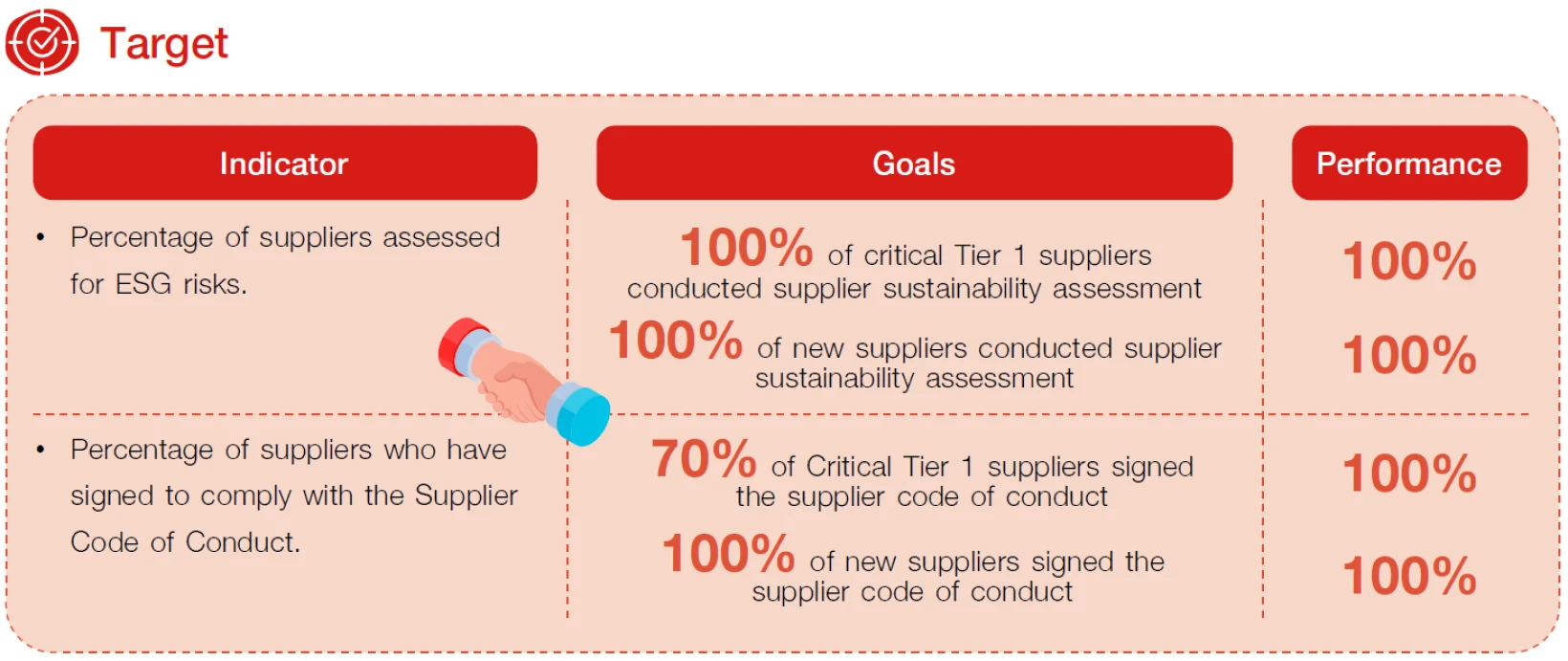
In 2025, the Company developed a Supplier Code of Conduct and a Code of Ethics. All Critical Tier 1 suppliers and 100% of new suppliers signed an acknowledgment of compliance. The Company plans to expand the group of Critical Tier 1 suppliers and to communicate its Sustainable Supply Chain Policy on the Company’s website to guide and encourage suppliers throughout the supply chain to comply with the Supplier Code of Conduct. These actions aim to promote socially and environmentally responsible procurement, support efficient resource utilization, foster social and community responsibility, uphold human rights principles, and enhance transparency and sustainability throughout the supply chain.
Furthermore, the Company has communicated its anti-corruption policy and announced its intention to join the Thai Private Sector Collective Action Against Corruption (CAC) to all suppliers. The Company encourages its suppliers to fight against corruption and strictly requests their cooperation in refraining from the giving or receiving of gifts.
- Sustainable and Responsible Major Raw Material Sourcing
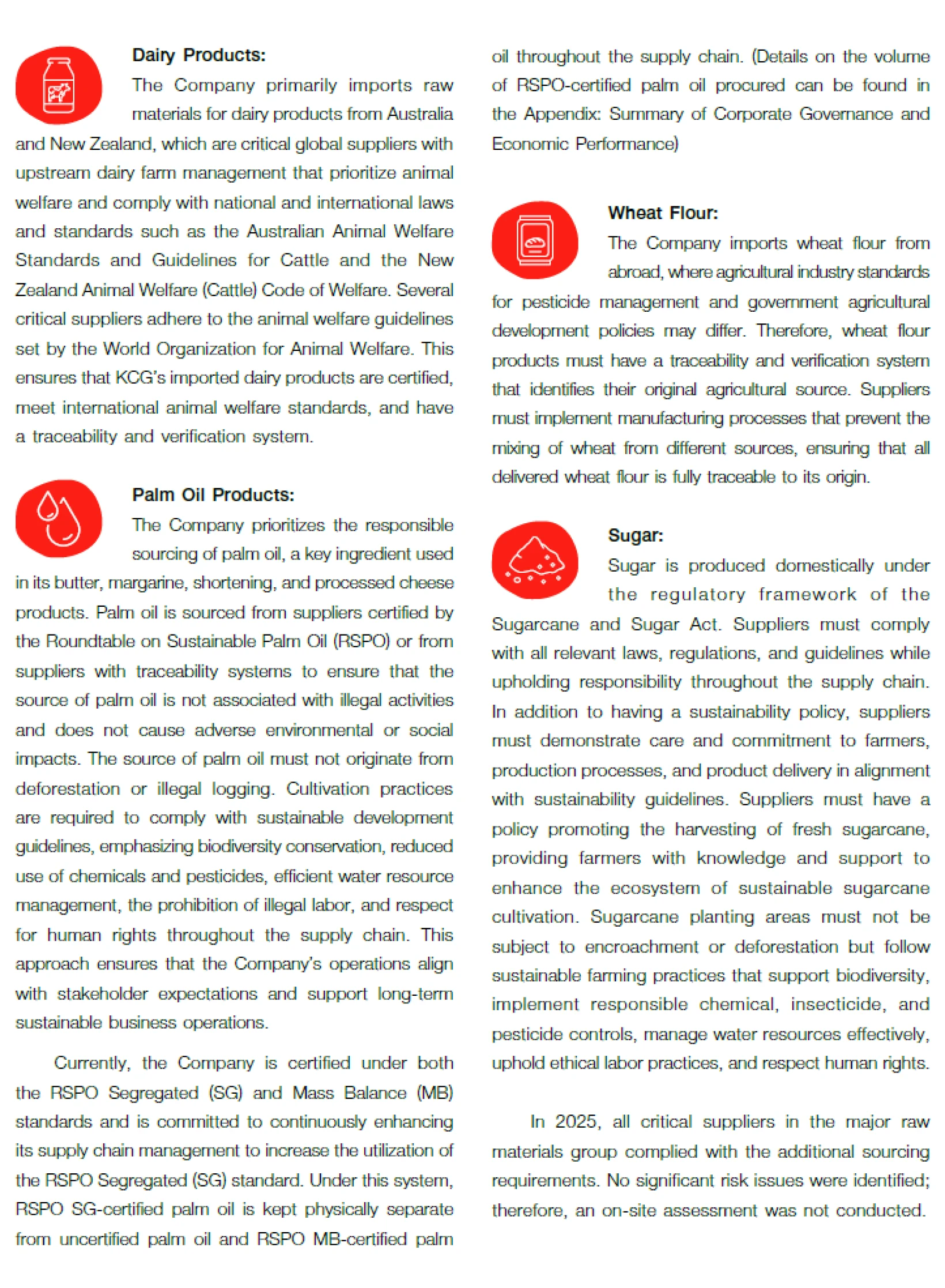
The Company has additional requirements for the major raw material sourcing, including dairy products, palm oil products, wheat flour, and sugar, ensuring that they come from sustainable and responsible sources.
- Green Procurement Policy
The Company has established an environmental procurement policy and developed a procurement manual for environmentally friendly goods and services. This guideline serves as a framework for sourcing and selecting goods and services based on defined criteria and qualifications for each product category. The objective is to encourage suppliers to consider efficient resource utilization, reduced environmental impact, and environmental protection throughout the product life cycle.
Procurement decisions for goods and services are based on environmental friendliness, suitability for use, effectiveness, quality, and cost-effectiveness. This applies to products and services with significant environmental impacts, such as electrical appliances and office equipment, computers and electronic equipment, vehicles, advertising and public relations services, electrical products, construction works, and cleaning services.
In addition, the Company imports aquatic products, such as lobsters and other seafood, from both international and domestic sources for distribution. The Company places strong emphasis on the supplier and carrier selection, applying strict food safety, quality control, and traceability standards throughout the supply chain, in compliance with the laws and regulations of the country of origin. This includes adherence to relevant standards and food safety control systems, such as the U.S. Shellfish Sanitation Program (SSP). The Company also reviews documentation and evidence relating to responsible marine resource management and sustainability practices at the source, including sustainable fisheries certification or documentation and equivalent data.
These measures support the procurement of high-quality, safe, and standardized seafood while minimizing environmental and social impacts to the extent that the Company can appropriately manage and control.
3. Supplier Assessment
The Company conducts post-evaluations of supplier performance annually, covering aspects such as quality, food safety, and compliance with Company regulations. If assessment results do not meet the specified criteria, the Company establishes corrective measures for the supplier to implement within a defined timeframe and systematically monitors progress. If the supplier fails to implement improvements as agreed, the Company engages in discussions to determine appropriate corrective actions or to explore alternative supplier options, based on the level of risk and potential impact on the Company.
Regarding supplier audits, the Company conducts on-site audits annually in collaboration with the Purchasing Department and Corporate Quality Department. Suppliers selected for audit include those presenting quality or food safety risks, operational deficiencies, or the need for improvements to quality management systems and food safety certification standards, as well as those identified as having elevated sustainability risks. The Company continuously monitors the implementation of corrective actions until completion. If the risk results from supplier limitations that cannot be effectively resolved and may affect the Company, additional measures may be implemented or alternative suppliers may be considered.
In 2025, the Company integrated ESG risk assessment into its annual on-site supplier audit process, covering 100% of suppliers subject to quality audits. The audit results did not identify any suppliers with sustainability issues or non-compliance with the Company’s sustainability requirements that required special follow-up. The Company plans to utilize these results to further develop and enhance its ESG risk assessment framework for suppliers in the future.
4. Development of Supplier Collaboration
The Company prioritized collaborating with suppliers on product, services, and packaging development, as well as promoting potential and sustainable business operations with suppliers by carrying out the following projects.
- Vendor Managed Inventory (VMI) Project
The Company has collaborated with its suppliers on a Vendor Managed Inventory (VMI) project. This inventory management model enables suppliers to plan and manage the Company’s inventory based on the systematic and continuous exchange of relevant supply chain information. The project aims to enhance inventory management efficiency, mitigate the risks of stock shortages or excess inventory, and strengthen business resilience for both parties.
In implementing the project, the Company and its suppliers jointly determined optimal inventory levels and shared information on future product demand. This enabled suppliers to plan production and delivery more efficiently, align with the Company’s demand, and reduce lead response times in the delivery process.
As a result of the VMI project, the Company has improved inventory management efficiency, increased the accuracy of product deliveries and inventory levels, and strengthened business relationships with its suppliers
Furthermore, the Company has expanded the VMI project to include suppliers in other product groups with the potential and readiness to participate, with plans for expansion in the future to enhance overall supply chain efficiency and support sustainable business growth.
- Supplier Sustainability Engagement
The Company prioritizes supplier collaboration throughout the supply chain to jointly develop innovations and elevate tangible sustainability operations. One key project is the “The Sustainable Pallet: Breathing New Life into a Sustainable Value Chain” a collaboration with logistics suppliers to develop specially formulated, food-grade recycled plastic pallets that meet food safety standards and enhance logistics efficiency across the supply chain.
The project enhances the efficiency of transportation, storage, and product handling through the Shuttle Pallet System. This system reduces product damage in the warehouse, minimizes resource waste, and improves overall logistics management efficiency. In addition, the sustainable pallet ESG for the future is designed to be 100% reusable and recyclable, in alignment with the Company’s green projects and net-zero greenhouse gas emission targets.
The Sustainable Pallet: Breathing New Life into a Sustainable Value Chain reflects the Company’s approach to creating shared value with suppliers. Besides reducing environmental impacts, the project creates new business opportunities and revenue for suppliers within the supply chain while strengthening the competitiveness and long-term sustainability of the food logistics system.
This collaboration has received national recognition. The Company was awarded the Commended Supply Chain Management Award 2025 in the Sustainability Excellence category at the SET Awards 2025, organized by the Stock Exchange of Thailand in collaboration with Money and Banking Magazine. This recognition reflects the Company’s success in integrating sustainability into supply chain management and establishes a foundation for sustainable pallet ESG standards in the food industry that can be further adopted and expanded in the future.

For more information available in:
The Company has initiated sustainability projects or activities with suppliers, focusing on environmental and social dimensions such as a backhauling project, in which the Company collects products from its suppliers on the return trip, lowering transportation costs for suppliers and reducing unproductive return trips for the Company. This also helps to reduce greenhouse gas emissions in the supply chain. Furthermore, the Company collaborates with suppliers to create eco-friendly packaging, such as paper-made gift baskets, to increase the proportion of eco-friendly packaging. The Company advises suppliers on improving their quality systems and food production safety standards framework, ensuring that the Company receives standardized raw materials or products.
Accounts Payable Days
The Company strictly adheres to the terms and conditions of payment agreements with suppliers, accounts payable, and receivables. The financial and accounting department processes payments through banking channels, ensuring suppliers receive timely payments. Accounts payable days may differ depending on the product, business type, or commercial conditions. The credit terms determine the accounts payable days as agreed upon with suppliers, depending on various factors such as the nature of the business, the longevity of the partnership, and any other relevant factors. The average accounts payable is 60 days. The Company has defined and communicated the accounts payable days to its suppliers. In the event of an emergency or other situation that may cause payment delays, the Company will promptly notify the suppliers, explain the reasons, and reschedule the payment as needed, either immediately or in advance, depending on the circumstances.

Remark: 1 The criteria have been revised to cover a broader range of suppliers.
Performance
KCG Sustainability Performance Data 2025 - Governance and Economic Performance