Climate Change Adaptation and Decarbonization
The Company has recognized the impacts of climate change on the environment, society, politics, and the economy, which inevitably affect the Company’s business operation. Therefore, the Company has undertaken an assessment of climate-related risks and opportunities and manages its operations in alignment with the Company’s and Thailand's greenhouse gas emission reduction targets.
Policies and Management Approach
Climate Change Governance
The Company has established a framework for greenhouse gas emission reduction and climate change adaptation under the Sustainability Policy. The Corporate Governance and Sustainability Committee provides oversight, guidance, and policy direction to ensure that climate management and greenhouse gas reduction are aligned with the Company’s overall sustainability strategy and objectives.
To enhance the agility and effectiveness of climate action, the Chief Executive Officer and Managing Director have appointed a Sustainability and Risk Management Working Team. Comprising senior executives and representatives from relevant departments, the team is responsible for setting targets, formulating action plans, and driving sustainability operations covering climate adaptation, greenhouse gas reduction, energy management, and resource efficiency, in alignment with the Company’s Net Zero policy and targets.
In addition, the Company has established an Enterprise Carbon Footprint Management Working Team responsible for compiling the carbon footprint of organization (CFO) data and submitting it annually for certification by the Thailand Greenhouse Gas Management Organization (Public Organization). This ensures that greenhouse gas reporting is accurate, transparent, and consistent with nationally and internationally recognized standards.
From an organizational structure perspective, the Company has established a Corporate Sustainability Division that is directly responsible for driving sustainability and oversight of climate change. The greenhouse gas emission reduction target is one of the key performance indicators (KPIs) for senior executives within this division in order to merge the strategic oversight with operational execution.
At the operational level, the Production Department and the Engineering Department, as well as the Safety, Health and Environment (SHE) Department, are assigned primary responsibility for implementing energy conservation projects, improving resource efficiency, and undertaking environmental investments to reduce greenhouse gas emissions to achieve the Net Zero target.
Climate Change Management
The Company adopts climate change management and greenhouse gas reduction guidelines in accordance with the framework of the Thailand Greenhouse Gas Management Organization (Public Organization). In addition, the Company has reviewed and incorporated relevant disclosure guidelines of the Task Force on Climate-related Financial Disclosures (TCFD), IFRS S2 and the Stock Exchange of Thailand (SET)’s Guidelines on Data Management and Greenhouse Gas Emission Reduction for the Agriculture and Food Industry Sector to ensure alignment with the Company’s Net Zero target.
Climate Change Risk Management
The Company has assessed climate change risks based on the Task Force on Climate-Related Financial Disclosures (TCFD) guidelines to identify and evaluate its impacts on operations in all dimensions, analyzing risks and risk likelihood from physical risks, which are natural disasters such as flash floods, storms, infectious diseases in plants and animals, rain bombs, and chronic disasters such as droughts in agricultural or livestock farming areas that may impact key raw materials which affect the Company's performance, business disruption in the production and transportation as well as the tendency of higher production costs of agricultural raw materials. This includes transition risks such as government policies, carbon pricing regulation, and information on climate change impacts, which may lead to reputation risks if targets are not achieved. Additionally, there are opportunities to develop products and packaging with innovations or new technologies. The Company incorporates these risks into its strategic planning to further develop an appropriate mitigation plan.
Mitigation Plans for Climate Change Risks
| Risk | Time Frame | Impact | Mitigation Plan |
|---|---|---|---|
| 1. Physical Risk | |||
|
1.1 Acute risks
|
Short term 0 - 1 year |
Business Disruption in production and transportation & other activities |
|
|
1.2 Chronic risks
|
medium term 2 - 5 years |
Shortage of fresh water in agricultural or livestock farming areas, affecting raw materials |
|
| 2. Transition Risk | |||
|
2.1 Government policy and GHG emissions regulations |
short term 0 - 1 year |
Carbon taxes may cause higher production costs and greater difficulty accessing funding sources |
|
|
2.2 Information disclosure on climate change impacts |
Medium term 2 - 5 years |
|
|
| 2.3 Costs to transition to lower emissions technology |
long-term 6 - 10 years |
To achieve the Net Zero Emissions target, the Company is required to invest in new technologies, resulting in increased capital expenditure and costs associated with technology and innovation. |
|
| 3. Opportunity | |||
|
3.1 Product and packaging development |
short term 0 - 1 year |
Customers and consumers value low-carbon products, presenting a market opportunity |
|
| 3.2 Production efficiency improvement |
Medium-term 2 - 5 years |
Opportunities to sustainably reduce costs and conserve resources through investments aimed at improving electricity and fuel efficiency. |
|
Disclosure of Greenhouse Gas Emissions
The Company has prepared data to assess the corporate carbon footprint of Thepharak Factory, Bang Phli Factory, the head office, Bang Na Branch, and distribution centers in Chiang Mai, Khon Kaen, and Surat Thani. This assessment covers all 3 scopes of greenhouse gas emissions in accordance with the Greenhouse Gas Emission Accounting and Reporting Standards. Prior to the disclosure of the greenhouse gas emissions, the collected data undergoes a verification process for accuracy by V Green KU Company Limited, a registered verifier certified by the Thailand Greenhouse Gas Management Organization (Public Organization). This process has been conducted annually for each branch since 2022. The Company received the carbon footprint of the organization: CFO certification from the Thailand Greenhouse Gas Management Organization (TGO). This certification is renewed annually. The Company applies the operational control approach to define the organizational boundary for its greenhouse gas inventory by compiling the volume of greenhouse gas emissions and removals occurring under the Company’s operational control, excluding overseas operations.
For Scope 3 greenhouse gas emissions, the Company conducted a materiality assessment across all 15 categories and identified five as significant. Emissions data were compiled for these five categories, and corresponding greenhouse gas reduction targets have been established.
In 2024, the Company consolidated greenhouse gas emissions data from all branches into a single corporate-wide emissions account. This approach ensures accurate reporting, reflecting the Company’s actual emissions and activities while preventing the double counting of inter-branch operations. The Company’s greenhouse gas emission data has been verified by V Green KU Co., Ltd., an independent verification body accredited by the Thailand Greenhouse Gas Management Organization (TGO). The greenhouse gas emissions reporting is conducted in accordance with internationally recognized standards1 with reference to ISO 14064-1:2018 and the GHG Protocol (2001, 2004).
In addition, the Company prepares a Sustainability Report disclosing greenhouse gas emissions information in accordance with GRI. The information is verified and presented to the executive committee for consideration, and the performance results are reported annually to the Corporate Governance and Sustainability Committee for acknowledgment prior to public disclosure.
Remarks: 1Based on the ‘Guidelines for the Calculation and Reporting of Organization Carbon Footprint’ published by the Thailand Greenhouse Gas Management Organization (TGO).
Greenhouse Gas Emissions Targets
The Company has established its greenhouse gas emission reduction targets based on a defined baseline year in alignment with the Science Based Targets initiative (SBTi)1. This science-based approach supports the objectives of the Paris Agreement to limit the increase in global average temperature to well below 2°C and pursue efforts to limit the increase to 1.5°C. The Company utilized the SBTi tool to set near-term and long-term targets covering Scope 1, Scope 2, and Scope 3 emissions. In addition, the Company has set a Net Zero target for 2050, aligning with Thailand’s national Net Zero commitment as announced at COP30 on November 19, 2025.
Near-Term Targets (2024-2029):
- Reduce Scope 1 and 2 greenhouse gas emissions by 10% by 2025, using 2024 as the base year.
- Reduce Scope 1 and 2 emissions by 20% and Scope 3 emissions by 15% by 2027, compared to the base year of 2024.
Long-Term Target (2030 and beyond):
- Reduce Scope 1 and Scope 2 greenhouse gas emissions by 42% and Scope 3 emissions by 25% by 2030, compared to the 2024 baseline year.
- Reduce Scope 1, Scope 2, and Scope 3 greenhouse gas emissions by 73% by 2045, compared to the 2024 baseline year.
Net Zero Targets
- Reduce greenhouse gas emissions to net zero by 2050.
Decarbonization Plan and Net Zero Action
The Company has developed a Net Zero Action Plan to support the achievement of its greenhouse gas emission reduction targets in both the short and long term, as follows:
- Near-Term Plan: The Company focuses on reducing greenhouse gas emissions from its internal operations by prioritizing improvements in electricity and fuel efficiency, increasing the proportion of renewable electricity consumption, and enhancing waste management. A short-term greenhouse gas reduction plan has been developed and submitted to the Stock Exchange of Thailand’s JUMP+ program, outlining three key strategies to reduce Scope 1 and Scope 2 emissions:
1. Energy Consumption Optimization
2. Process Efficiency Improvement
3. Renewable Energy - Medium- and Long-Term Plans: The Company is currently reviewing its long-term greenhouse gas reduction targets and roadmap toward Net Zero. This review takes into account the changing business context and the Company’s growth strategy, particularly as Scope 3 emissions represent the largest share of total emissions. The Company therefore prioritizes the development of strategies to reduce Scope 3 emissions, with a focus on strengthening collaboration with suppliers and stakeholders across the value chain to support the sustainable, long-term achievement of its Net Zero target.
Remarks: 1The Science Based Targets initiative (SBTi) was established through a collaboration among WWF (World Wide Fund for Nature), CDP (Carbon Disclosure Project), WRI (World Resources Institute), and the UN Global Compact (UNGC).
Performance
Greenhouse Gas Emissions Performance
In 2025, the Company reported total Scope 1 and Scope 2 greenhouse gas (GHG) emissions of 19,688 tCO₂eq, representing a 6.7% reduction from the 2024 base year. Meanwhile, GHG emissions intensity (Scope 1 and 2) per unit of production was 0.51, a 3.9% decrease from the base year. However, this performance did not meet the reduction targets of 10% and 5%, respectively.
Total GHG emissions (Scope 1, 2, and 3) amounted to 133,606 tCO₂eq, an increase of 25% from the 2024 base year. The main source of emissions was Scope 3, accounting for approximately 85% of total emissions. The 29% increase in Scope 3 emissions was primarily driven by the Purchased Goods and Services category, particularly raw materials used in production, which increased by 19% compared with the base year, in line with the Company’s sales growth. For Scope 1, GHG emissions increased in line with higher production volumes and sales, mainly due to increased LPG consumption in the production process.
Meanwhile, the Company achieved a significant reduction in Scope 2 emissions through the installation of solar rooftop power generation systems and the continuous implementation of energy efficiency improvement initiatives, resulting in reduced electricity consumption from external sources and lower energy costs.
Greenhouse Gas Emissions
Greenhouse gas emissions1 (unit: tCO2eq)
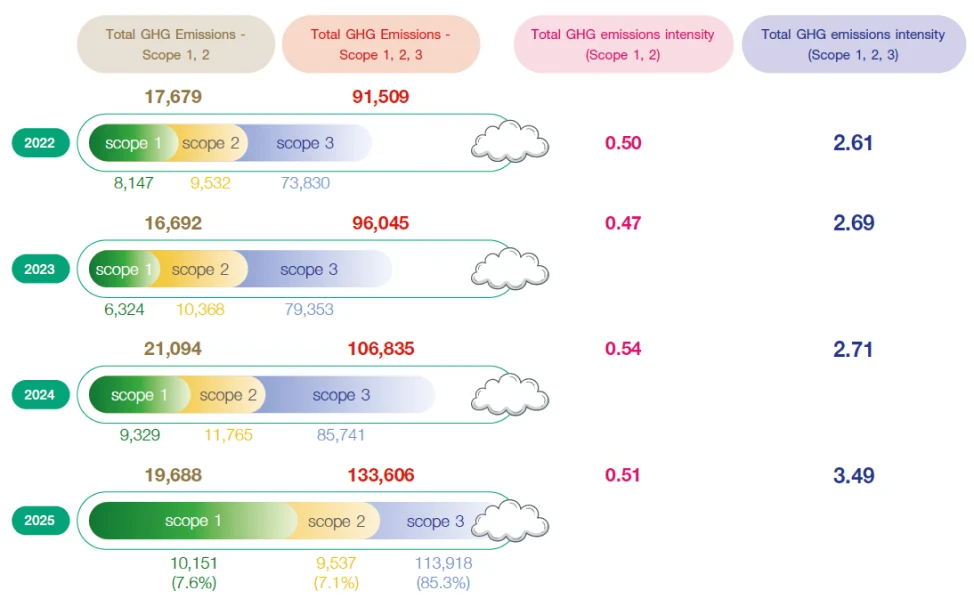
Remarks: 1This excludes the greenhouse gas emissions of subsidiaries. There is a plan to calculate greenhouse gas emissions for subsidiaries in 2025.
Overview of Green Logistics Performance
The Company implemented environmental and supply chain management plans aimed at reducing greenhouse gas emissions by increasing the use of renewable energy, particularly solar energy, and improving supply chain management, especially in transportation and storage, under the concept of Green Logistics in order to support environmental strategies and energy management to reduce greenhouse gases. The projects are as follows:
- Increase Renewable Energy Consumption
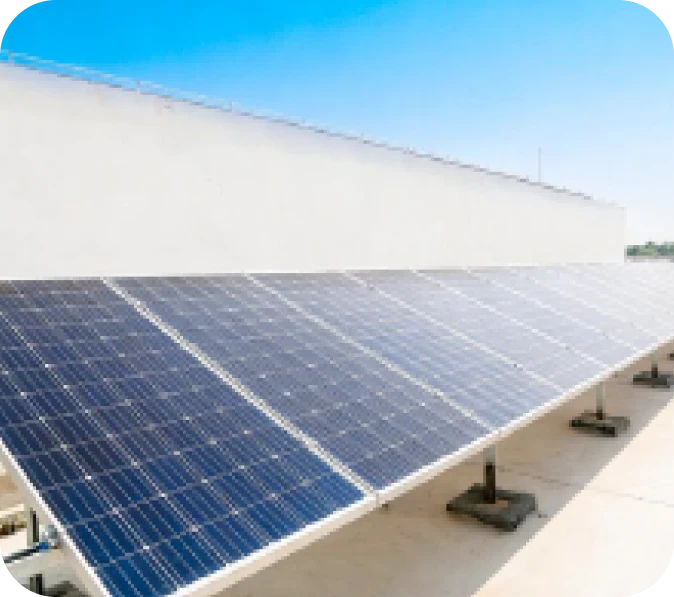
Installing solar roof at KCG Logistics Park and distribution centers in Chiang Mai, Surat Thani, and Khon Kaen
- Installed solar roofs at 5 branches with a total installation capacity of 2,358 kW.
- Electricity consumption from the solar roofs: 2,978,652.25 kWh per year.
- Reduced greenhouse gas emissions by 1,489 tCO₂eq
- Increase EV trucks and Electric Forklifts
Gradually transition to electric forklifts, replacing traditional gas-powered models to reduce greenhouse gas emissions. Additionally, electric forklifts do not produce smoke or exhaust fumes which helps reduce air pollution and enhances employee safety, as there is no need to store fuel, which is a flammable substance that can cause a fire.
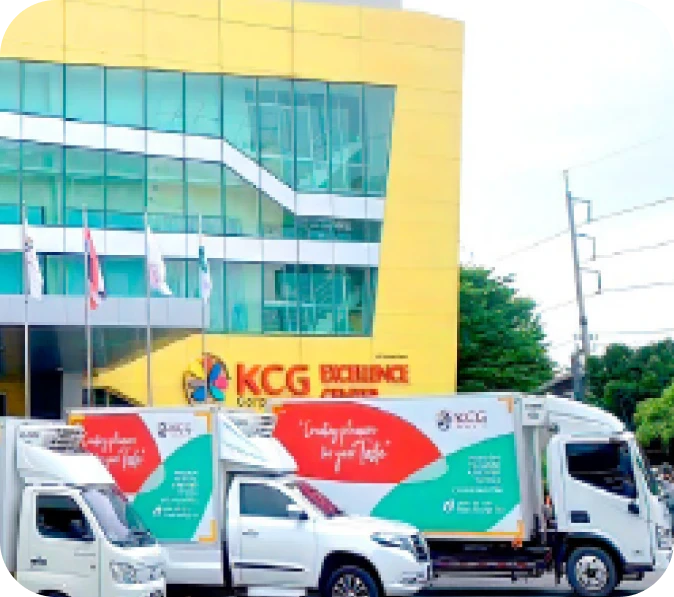
- Operate a fully electric fleet of 10 vehicles for product delivery from distribution centers to customers in Bangkok and Chiang Mai, comprising two 6-wheel trucks, six 4-wheel trucks, one 4-door pickup truck, and one car.
- Convert all forklifts at KCG Logistics Park, including warehouses and provincial distribution centers, to electric (lithium battery) models, totaling 62 units.
- Install three electric vehicle charging stations within the KCG Logistics Park area to support fleet operations.
- Development of Eco-Friendly Packaging
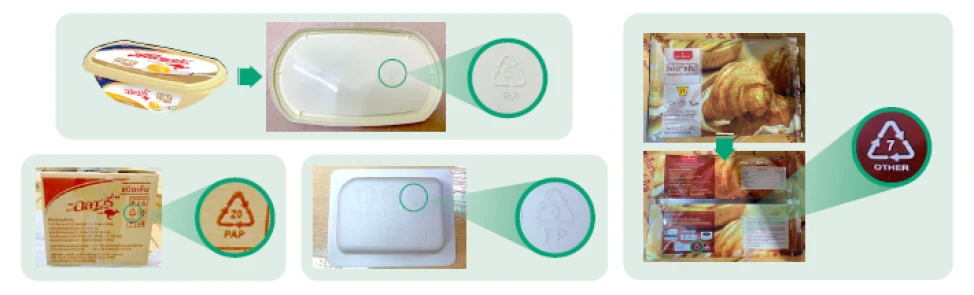
The Company is increasing the proportion of eco-friendly packaging while maintaining product quality. This is achieved through the modification of packaging materials to more sustainable alternatives, such as replacing non-biodegradable plastics with biodegradable or recyclable materials
In addition, the Company is reducing material consumption by optimizing the size and structural design of cardboard boxes to ensure adequate product protection during transportation. The Company is conducting a feasibility study to reduce the thickness of steel used in canned packaging to minimize material consumption.
Furthermore, the Company plans to transition its plastic film packaging to mono-material structures that are easier to segregate and recycle, along with using clear recycling symbols on packaging. In 2025, more than 66% of the Company’s packaging materials are recyclable.
- Creating a Corporate Culture
The Company communicates and integrates greenhouse gas reduction and environmental stewardship into various employee engagement activities, including the KCG Innovation Contest and KCG Kaizen programs. These projects provide opportunities for employees to propose innovations and process improvements that contribute to greenhouse gas reduction and business value creation without causing adverse environmental impacts, including communication and implementation of the activities.
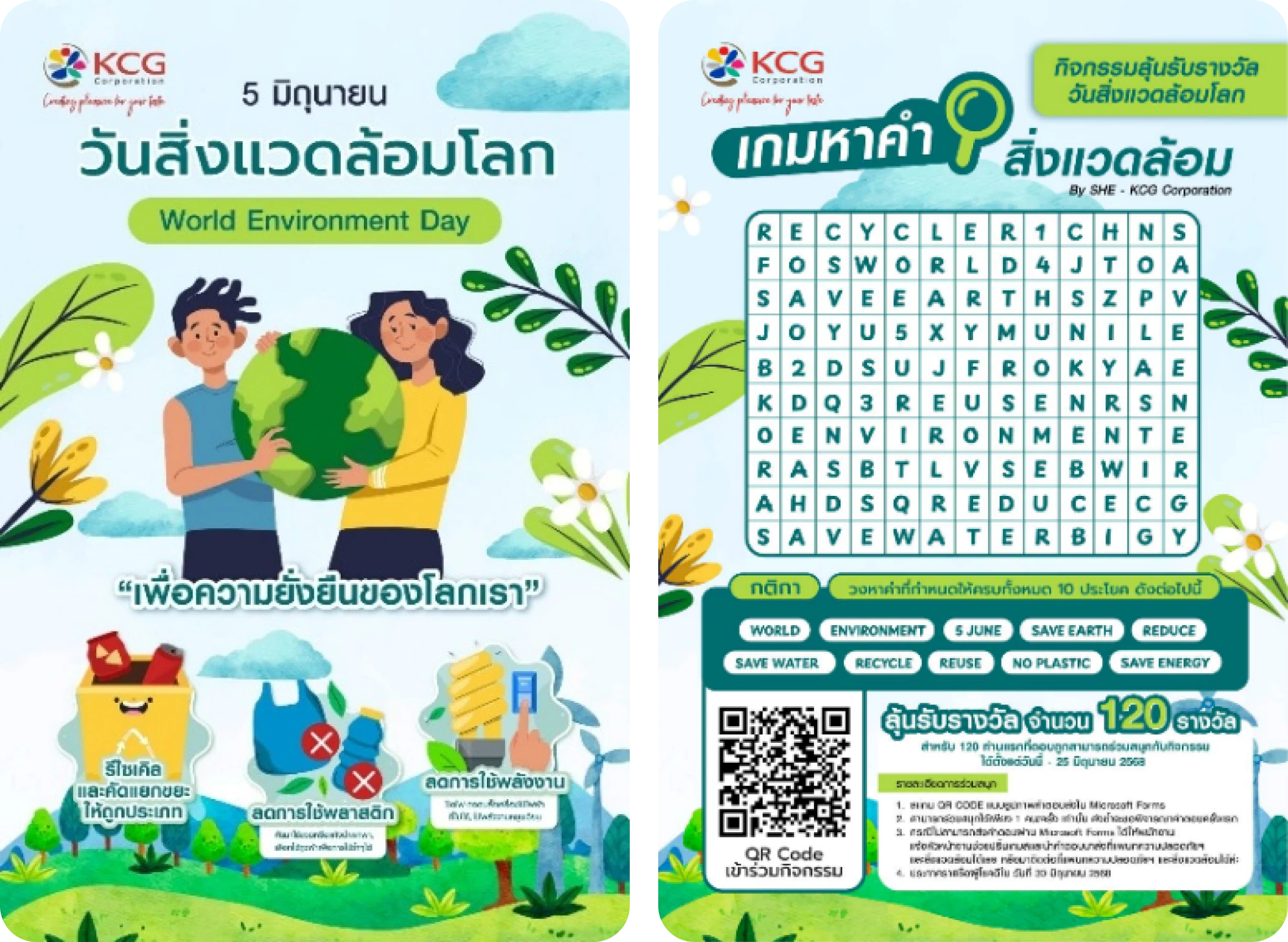
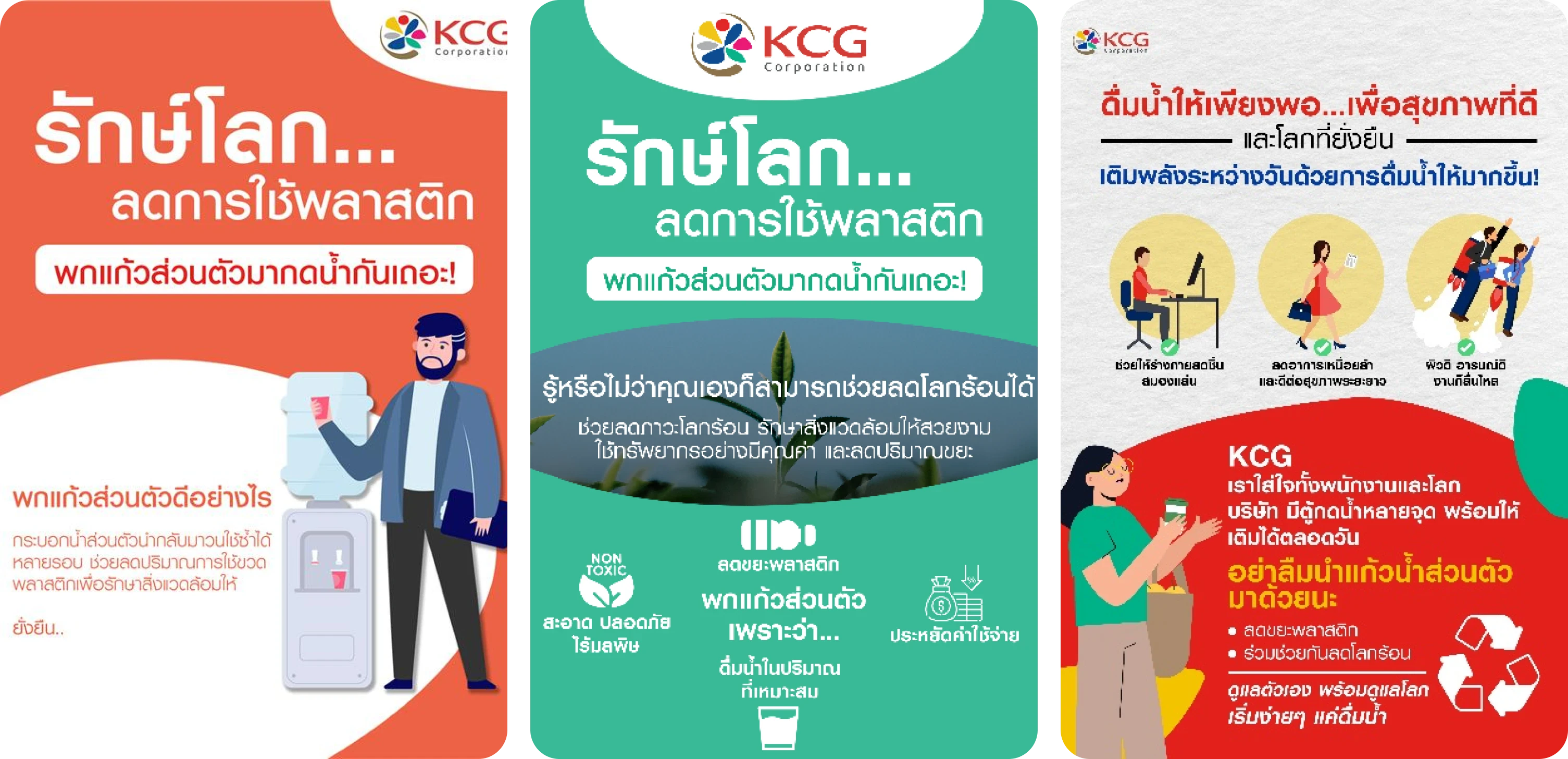
Environmental awareness campaigns are conducted to encourage all employees to recognize the importance of environmental stewardship and to reduce greenhouse gas emissions.
World Environment Day 2025
Plastic Reduction Campaign
KCG Sustainability Performance Data 2025 - Environmental Performance